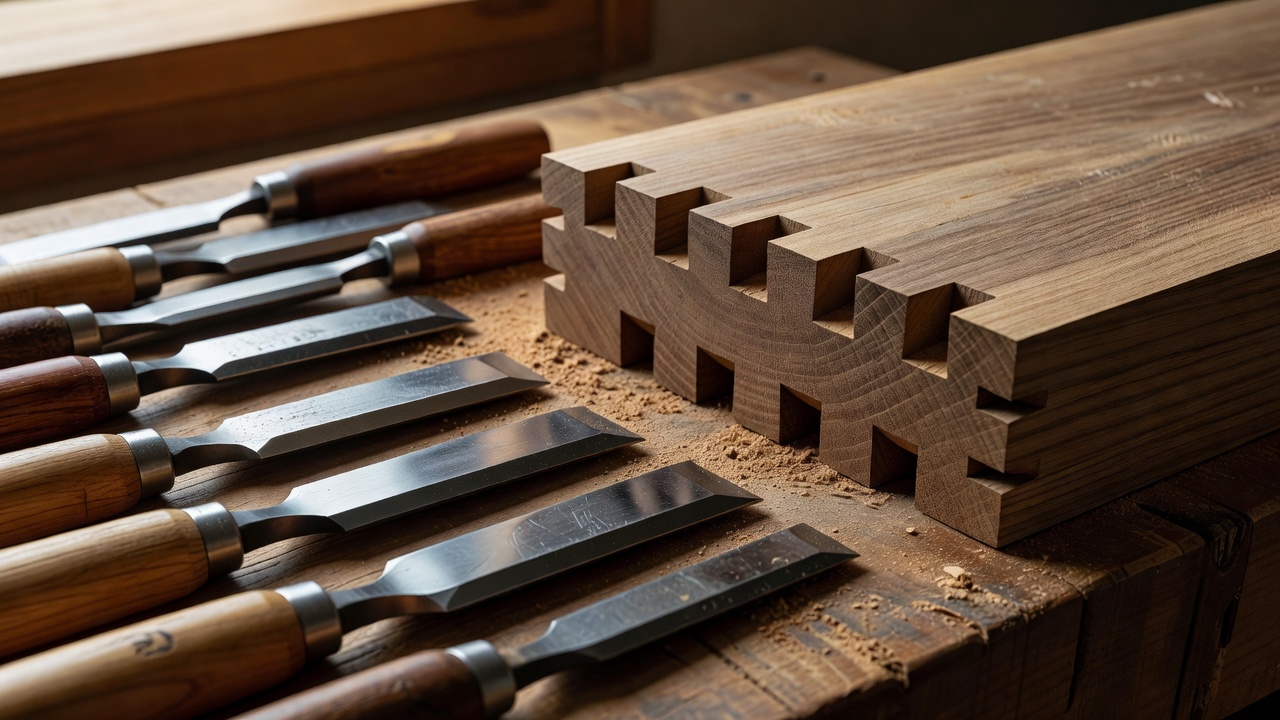
While machines excel at removing bulk material rapidly, they are fundamentally limited to producing round corners. To create crisp, interlocking joinery—such as dovetails, through-tenons, and intricate mortises—a craftsman relies on the chisel. A chisel is structurally simple, consisting solely of a handle and a hardened steel blade, yet mastering its variations and maintenance requires a deep understanding of metallurgy and mechanics.
Types of Chisels
Not all chisels are designed for the same impact or precision. They are categorized by the geometry of their blades and the design of their handles.
- Bench Chisels: The most common category, featuring bevel edges that allow them to fit into tight corners, such as the acute angles of dovetail joints. They are versatile, capable of both light chopping and delicate paring operations.
- Mortise Chisels: Designed specifically for chopping deep holes (mortises) into solid timber. They feature thick, rectangular cross-sections (often referred to as "pigstickers") to prevent flexing and bending when leveraged aggressively to pry out waste wood.
- Paring Chisels: Exceedingly long, thin blades designed strictly for hand-pushing rather than mallet strikes. The length provides a broad reference surface, allowing the user to slice away ultra-thin layers of wood when fitting complex joints.
Western vs. Japanese Traditions
The philosophical approach to chisel construction varies dramatically across cultures, most notably between Western and Japanese designs.
Western Chisels typically utilize a homogeneous piece of steel—often O1, A2, or Chrome Vanadium alloy. The handles are attached either via a tang (a spike driven into the handle) or a socket (where a cone-shaped handle sits inside a steel cup). Socket chisels are highly durable against mallet strikes as the impact seats the handle further into the socket.
Japanese Chisels (Nomi) utilize a laminated construction. A thin layer of incredibly hard, high-carbon steel (often white or blue paper steel) forms the cutting edge, forge-welded to a softer, shock-absorbing wrought iron backing. The hard steel takes an edge sharper than almost any Western chisel, while the soft iron prevents the brittle steel from shattering under impact. The backs of Japanese chisels are hollow-ground (ura) to reduce the surface area that must be flattened during sharpening.
Sharpening: The Micro-Bevel Strategy
A dull chisel is dangerous; it requires excessive force, leading to a lack of control. Sharpening is non-negotiable.
The back of a chisel must be lapped perfectly flat so that when the bevel intersects it, a perfectly straight, flawless edge is formed. For the bevel side, most professionals use a primary grinding angle (around 25 degrees) and a secondary "micro-bevel" (around 30 degrees). By raising the angle slightly for the final honing on a high-grit stone, you only remove material at the very tip, drastically reducing sharpening time while maximizing edge durability.